
Record numbers of people are heading outdoors. But the agencies that safeguard public lands are in trouble. Here’s what each of us can do.
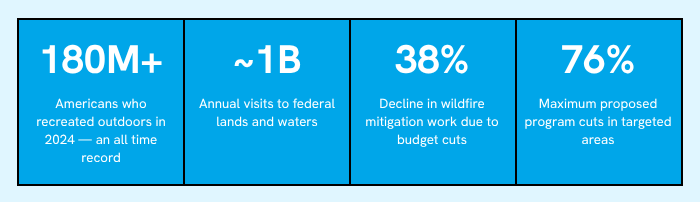
Picture a mountain meadow, a canyon trail, or a lakeside vista. All of these options are appealing — you might be wishing that you were enjoying one of them right now. More than 180 million Americans share that feeling. In 2024, a record 58% of all Americans aged 6 and older recreated outdoors. Federal lands and waters alone welcomed nearly one billion visits last year.
Outdoor recreation has never mattered more to our collective health and happiness. So the news from Washington hits especially hard. Budget cuts to the U.S. Forest Service and Bureau of Land Management in 2025–2026 have been severe: proposed reductions of 35% to 76% in research divisions and program areas, workforce losses of 10–30%, and a 38% decline in wildfire mitigation work. The National Park Service, despite overseeing some of the nation’s most iconic natural areas, has seen more than 4,000 jobs cut since February 2025.
Many of the trails, campsites, and wild corridors we love depend on these federal agencies — and right now, they’re stretched dangerously thin.
The agencies entrusted to protect natural areas are facing their most severe budget cuts in a generation.
What can you do? The answer is twofold — and both parts matter.
Part one: Make your voice heard in Washington
In April, Leave No Trace joined 70 organizations and businesses representing the outdoor recreation community in signing a letter to Congress. The message was clear: fully fund the agencies that steward our public lands.
The letter calls on lawmakers to allocate $100 million to BLM’s Recreation Resources Management program and $70 million to the USFS Recreation, Heritage, and Wilderness programs — along with matching salary increases for Forest Service staff. It also urges full implementation of the EXPLORE Act (Expanding Public Lands Outdoor Recreation Experiences), which directly addresses the surging demand for outdoor access across all federal lands.
A brief message to your senators and congressional representatives can make a real difference. Lawmakers hear from industry lobbyists every day — they need to hear from constituents who love the outdoors. Visit usa.gov/elected-officials to contact your representatives.
Part two: Keep practicing — and share your knowledge
Contacting lawmakers creates change at the policy level. But there’s something else each of us can do — something that makes a difference every single day, on every trail, at every campsite.
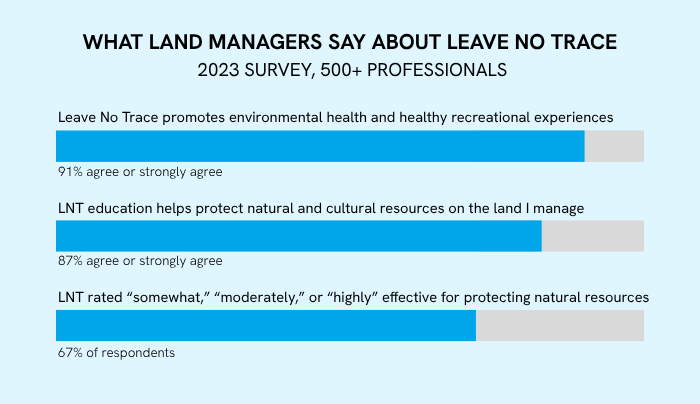
Land managers overwhelmingly believe that visitor behavior is one of the most significant factors in the health of natural resources. A 2023 survey of more than 500 professional land managers found that two-thirds rated Leave No Trace as effective for protecting natural resources. Yet nearly 9 in 10 also reported that most visitors have only a limited or average understanding of Leave No Trace practices.
Does Leave No Trace really make a difference in protecting public lands? Land managers overwhelmingly think that it does. According to a 2023 survey of land management professionals:
- 91% agree that “Leave No Trace promotes and protects the health of the environment, and therefore also promotes healthy recreational experiences.”
- 87% agree that “Leave No Trace education helps protect the natural and cultural resources on the land that I manage.”
Alarmingly, that same survey revealed that 89 percent of land managers rated visitor knowledge of Leave No Trace as “limited” or “average.”
That gap — between LNT’s proven value and how little most visitors know — is where each of us comes in. You already know the 7 Principles. The people you hike with, camp with, and introduce to the outdoors may not. Teach one person, and you’ve doubled your reach. When more visitors tread lightly, land managers can spend less time responding to damage and more time on the stewardship that keeps these places healthy.
Two actions. One purpose.
The public lands crisis is real — but so is our power to respond. Contacting lawmakers keeps the political pressure on to restore funding. Practicing and sharing Leave No Trace reduces the strain on already-stretched land managers right now, today, on the ground.
Neither action replaces the other. Both are needed. The wilderness that has always been there for you is counting on you to show up for it.
Start with whichever feels most natural — join our campaign and message your representative, take a refresher on the 7 Principles before your next trip, or share this post with someone who loves the outdoors as much as you do.


